Showing posts with label Olympics. Show all posts

Friday, January 13, 2017

Great Men Departed - 2016

Coach John Alire (1977) - an accurate portrayal of
the man though the color is poor
The year just ended was a somber one for Santa Fe's running community due to the passing of two giants: John Alire (1930-2016) passed in May; Dan Maas (1970-2016) left us in September. The trails and outdoors community also lost Dale Ball (1924-2016) who passed in February.

Alire coached the fabled Santa Fe High Cross Country team for more than two decades, 1973-1996. His teams won a combined twelve state titles in this span and he coached four individual champions - Graham ('79), Bigbee ('81), Romero ('87), O'Shea ('91). The 1977 boys team finished the season ranked 3rd nationally by Harrier Magazine, the 1978 boys team won the AAU national championship which happened to be hosted in Albuquerque, and the 1986 girls team won another AAU title in San Francisco. For these successes specifically he was recognized with a mention in Sports Illustrated. I was fortunate to run for him in my formative years just before he left coaching. Alire was an impressive man and I admired him greatly. He will be missed.

1992 Oly Trials - Dan running third, blue vest
Danny Maas was a state champion runner for Santa Fe Prep in the 1980's and later for Adams State College in Alamosa where he was won multiple national championships and eventually broke four minutes in the mile. He still holds the Adams State record in the 1500m. Dan strung together three consecutive titles at the La Luz Trail Run, the last Santa Fean and norteño to win the race. He later competed in two Olympic Trials in the 1500m ('92 and '96), making the finals in the former (8th, 3.39.68). Notably, he is described as being so genuine among friends and so skilled and accomplished in his profession that he is more widely known for these reasons than his success as an athlete. The guy was a legend.


Dale Ball
Dale Ball brought the vision, design, steered the funding, management, and finally the building efforts of his eponymous trail east of town. The Dale Ball Trail system is now an iconic piece of Santa Fe. His efforts established legal public access along nearly the full length of the Santa Fe foothills. That he had the skill and drive to link together more than a dozen parcels of land in the highest valued real estate in town is extraordinary. He then established a land trust, the Santa Fe Conservation Trust, to manage this conserved tract of land (and the trails now bound to it) and others like it.

The accomplishments of these three men will stand on their own for decades to come.

John E. Alire - Obituary
Daniel R. Maas - Obituary
Dale Ball - Obituary


Related Posts:
 - New Mexico's Four Minute Milers
 - The New La Piedra Trail - Dale Ball
 - Micah True (1953-2012)
 - The Tough Guy List
 - The Passing of a Friend - Colin Sutton (1975-2014)


Wednesday, June 29, 2016

Prep Miler With New Mexico Roots Qualifies for Olympic Trials

Aragon - Olympic Trials qualifier
Several high school athletes will be competing at this weekend's Olympic Trials in Eugene, including two high school seniors in the women's 1500m. Kate Murphy (Lake Braddock HS, Virginia) and Christina Aragon (Billings HS, Montana) both qualified by time with the #3 and #4 prep marks of all-time (4:07.21 and 4:09.27).

Aragon happens to be the youngest daughter of legendary New Mexico miler Chuck Aragon, a former Los Lunas HS state champion, an MD and graduate of UNM medical school, as well as the alternate on the 1984 Olympic Team in the 1500m. Her mother Kathy (Pfiefer) was a standout runner at UNM who qualified to run in the Trials more than once (3x to be specific).

Quality genetics led to multiple national championships on the track as a junior last year for Christina, and at a recent qualifying race in Portland she ran away from a field of professional and collegiate runners, just dipping under the Trials mark of 4:09.50, running solo and chasing the time by herself over the final lap.

Aragon is not expected to compete at the front for one of the spots on the Olympic team, her effort will be measured a success if she can make the finals. She has committed to run for Stanford in the Fall unlike her sisters and father who all ran for the University of Notre Dame.

See the bios and achievements of all sixteen prep Trials qualifiers (12 girls, 4 boys). They include one current world champion, a couple junior world champions, and several national record holders.

Update:
Christina ran through to the semi-finals, missing out on a finals qualifier by two places finishing in 4:12:71. Kate Murphy also missed qualifying out of the semis.


Related Posts:
 - New Mexico's Four Minute Milers
 - New Mexico's Newest Olympic Hopeful (2016)
 - The Tough Guy List (Chuck Aragon)

Saturday, June 25, 2016

New Mexico's Newest Olympic Hopeful

UNM's Courtney Frerichs
The Olympic Trials are one week away and the NCAA Championships are two weeks past. This small window of time allows a moment to reflect on UNM's first and most recent individual national track champion, Courtney Frerichs. A member of last fall's national champion cross-country team, Frerichs ran away from the field in the 3000m steeplechase and soloed to the title as well as a new UNM and NCAA collegiate record in 9:24:41, breaking the previous record held by 1500m world champion Jenny Simpson by a little more than a second. Frerichs was NCAA runner-up last year running for University of Missouri Kansas City before applying as a graduate transfer to UNM for her final year of eligibility.

New collegiate 3000m steeplechase record
She was a heavy favorite to win the title, winning by nearly 100m. Her time however was exceptionally fast, 6th fastest all-time among US women, which now positions her for a realistic spot on the US Olympic team. She's currently the third US ranked woman by time:

  1. Coburn, 9:10.76 AR
  2. O'Connor, 9:18.85
  3. Frerichs, 9:24.41 CR
  4. Higginson, 9:33.38
  5. Cheever, 9:37.12 

This ranking comes with the caveat that two of the top 5 US women (Garcia, Quigley) have yet to compete this year. Both have PRs within one second of Frerichs new best. Should Frerichs find her way into the top three next week she'll be the first Olympian hailing from New Mexico since Shelly Steely and Aaron Ramirez in 1992.


Updated:
Left out a few athletes with local ties (naturally).

 - Santa Fe athlete Aliphine Tuliamuk-Bolton is one of a handful of Americans in legitimate contention for one of the 10,000m spots. She'll be competing this weekend at the US Trials.

 - Albuquerque Academy alum and prep track phenom Curtis Beach will compete for a spot in the Decathlon. He runs for Nike, and lives and trains in Arizona.

 - Former Lobo standout Ross Millington has punched his ticket to Rio and will be representing the UK in the 10,000m. He lives and trains in Europe.

 - Another former Lobo standout and European Champion Lee Emanuel has a shot at representing the UK in the 1500m. He needs to record a time of 3:36.20 by weeks end. Lee lives and trains in Europe.

Several other UNM sprinters and field event athletes will be competing in their respective nations trials this weekend. A write-up and list of these athletes was pulled together by the UNM athletic department.

Updated 2:
Courtney finished 2nd in 9:20.92 and will be running in Rio as an Olympian. So awesome.


Related Posts:
 - New Mexicans at the Olympic Trials Marathon (2016)
 - Chuck Aragon's Kid Earns a Trials Spot in the 1500m (2016)
 - Olympic Steeplechase Recap (London 2012)
 - A Brief Meeting with Billy Mills

Friday, February 12, 2016

New Mexicans at the Olympic Trials Marathon


Pay Smyth - 2015 XTERRA worlds
This year's Olympic Marathon Trials run Saturday in Los Angeles. Organizers report a record number of qualifiers (457) for the race, 211 men and 246 women of which a total of 373 appear entered to run. There will be a small New Mexican contingent out there including Magdalena Donahue (Sandoval) of Albuquerque/Los Alamos, Patrick Smyth of Utah/Santa Fe, and the Navajo Nation's Linnabah Snyder.

For Donahue this is her second Trials. She competed in Houston in 2012 but didn't finish the race, running three months pregnant at the time. Her qualifying time has improved though she's just four months removed from delivering her second child and a recent defense of her PhD dissertation. To be considered a national-class athlete in this context is somewhat extraordinary. Her father won this race in 1980. A recent Q&A with the Duke's Track Club can be found here, Magdalena's insight and training updates can be found here.

Donahue's personal photo-shop effort - 2012 Olympic Trials
Smyth has recently moved to Santa Fe to train with Ryan Bolton and his group of elites. He's originally from Utah, ran at the University of Notre Dame (HOW 'BOUT THEM IRISH!), and in his brief pro career has run World Cross Country (36th), collected 1st and 2nds at the US Mountain Running Championships (10th at Worlds), and is the three-time XTERRA world trail running champion.

Linnabah Snyder
Don't know much of Snyder other than she made it happen by one second with a 2:44:59 finish at the California Int'l Marathon, and will be on the line in LA tomorrow. Whole lot of respect for a runner that can get it done at that level.

NBC will be carrying the race live tomorrow, 1100am MT. All three 2012 Olympians on the women's side are running (Flanagan, Goucher, Devila). Meb Keflezighi is the only returning Olympic marathoner from 2012 on the men's side, Dathan Ritzenhein represented the U.S. in 2008 but finished fourth in the 2012 trials and later qualified in the 10,000m.

Men's 2016 Qualifiers
Women's 2016 Qualifiers

Update: I'm told Craig Curley of the Navajo Nation will be running as will UNM alums Shadrack Biwott and Chris Barnicle. Good luck to all.

Updated Results: Biwott 7th, 2:15:23; Smyth 8th, 2:15:26; Curley 98th, 2:42:55; Magdalena Donahue, DNF; Linnabah Snyder, DNF.
Full results here

Related Posts:
 - Olympic Marathon Trials (2012)
 - Armijo Runs to an Olympic Trials Qualifier
 - A Brief Meeting with Billy Mills
 - Meb Wins Boston

Friday, February 21, 2014

Sochi Olympics Trance

Ligety running a gate at a horizontal 50mph
can't. stop. watching. Olympics...

The Olympic Games as I see it, is this giant parade of total badasses. They show up every few years in their colors and banners on the world's biggest stage, showcasing one's certain perfected style or specialized technique, mad-skills in specific disciplines (I'm looking at you Netherlands and Norway), and in some cases their victory is so incredible and sudden that it's cast in carbonite, forever iconic. Sometimes their effort ends in failure so devastating and complete that it achieves similar status.

Incredible to watch all this, NBC commentary aside of course. My favorites are the skiing events, alpine or nordic, doesn't really matter. The amazing strength required to rocket down those alpine courses! Did anyone else see how technical and vertical those downhill/super-G courses were!? Good Lord. The other-worldly endurance and power of the nordic racers and biathletes - the Scandinavians are absolutely mesmerizing. To be a champion Norwegian skier is to be a modern day Norse God.

Team Norway crushing the collective dreams of several nations
It was nice to see Bode Miller stand on the podium one last time. I'm more of a Ligety guy, but Bode is hands-down the most successful American skier of all-time (he and Lindsey Vonn that is). Long ago I worked with a Swiss chef and he was big on alpine skiing. That was his sport. Every Sunday during the winter months he'd pass through the kitchen with the Boulder sports page hanging out of his back pocket asking us all rhetorically if we'd seen 'what da' hell' Bode had done in Europe the day before (pronouncing his name BOE-dey MEEL-ah). Chef was crushing hard on Bode because he was single-handedly preventing the Austrians from total domination on the World Cup circuit. My man Suissa couldn't stand his rival Austrians and he was equally appalled at the complete collapse of the Swiss alpine team. Bode allowed him to read the WC results and season standings for several years without crying in his espresso. Twelve years later the Swiss still suck, and Bode is still rocking championship podiums. USA...USA...USA...

Related Posts:
 - New Years at Squaw Valley
 - The Summer Olympic Vortex (London 2012)
 - A Brief Meeting with Billy Mills


Thursday, January 3, 2013

New Years in the Sierras

Squaw Valley's Olympic Rings
End of year generally means that I'm roaming a warehouse somewhere counting inventory. Living the dream sons! Ah, but for the second straight year the warehouse on my schedule was located near Tahoe, CA, so my off-days became a snowy wonderland of awesome. 

Set up base camp in Truckee where more than three feet of snow fell earlier in the week. I literally clicked into my nordic setup and skied off the porch and into the woods on several evenings. That, is living the dream.

Turns on the downhill slopes of Squaw Valley on New Years Day with the Desert Babe, where I snapped the sweet photo to your left there. 

This brings me around to a bit of trivia that I have dutifully researched: The US has hosted the Winter Olympics four times since their inception in 1924. Squaw Valley hosted in 1960. Without looking it up - who can tell me where and when were the other three US-hosted Winter Olympiads?

Leave your best guess in the comments. I'll add the answer Friday evening although I'm sure curiosity will get the better of the guesser well before then.

Sunset at Squaw

Sunrise in the Sierras

Wednesday, September 5, 2012

Olympic Marathon Recap

flanagan goucher marathon london
Goucher and Flanagan at right in the early miles
Continuing a short series of posts - A quick look back at the Olympic Marathons:

A few weeks have passed obviously since the conclusion of the men's and women's marathons, but the drama was top notch and the re-match isn't scheduled for another four years so we're going to go through it just the same. The women's marathon properly set off the second week of the Games on an early Sunday morning (led by Rupp's silver medal performance the evening before) . The Americans brought a strong team with Shalane Flanagan, Kara Goucher, and upstart Desi Devila. Flanagan was the one runner with truly elite talent and possible dark-horse aspirations. Devila was rumored to be injured, and she substantiated this by starting the race and dropping by 5K. Team Kenya were the heavy favorites (all three athletes), as was Russia's Liliya Shobukhova. But this was a marathon, and the London course was winding, narrow, and slicked with rain.

Flanagan Goucher london marathon
Goucher and Flanagan spent at the finish
Team Kenya moved first, breaking the race open just past the half-way mark. Shobukhova dropped due to injury soon thereafter. Flanagan and Goucher led the chase pack and Flanagan would eventually bridge only to be dropped at the next surge in pace. She would drift behind for some time then fade from the front over the last few miles ending up almost within reach of Goucher at the finish (Flanagan at 2:25:51 for 10th, Goucher at 2:26:07 for 11th). Hard to believe, but Joan Benoit's winning time of 2:24:52 from the '84 Games will remain the American Olympic record for at least another four years.

Up front the battle for medals was down to five women, Kiplagat (the reigning world champ) was dropped over the last 7K, and then the gold medal favorite Mary Keitany of Kenya cracked in the final mile after a move by unheralded but eventual champion Tiki Gelana of Ethiopa. Gelana finished in a new Olympic record time of 2:23:07, and was followed across the line by Jeptoo of Kenya and Arkhipova of Russia. It's an amazing thing to see the pressure build in a championship race of this caliber and then everyone throws down their cards and things get real over those last couple minutes. Full women's results here. Watch the full replay of the women's marathon here.

The two Americans walk-off with eleventh and tenth place finishes at the Olympic Games, Flanagan beaten and disappointed

The men's Olympic podium, Kiprotich at left
The men's race set off one week later, nearly the last competition of the Games. Heavy favorites once again were the entire Kenyan team - so good they left world record holder Patrick Makau, and Geoffrey Mutai, last year's Boston and NYC champion (who ran to course records at each race!) at home. Team Ethiopia arrived with a strong but less deep team, and the Americans brought American record holder Ryan Hall, Athens silver medalist and all around badass Meb Keflezighi, and three time Olympian Abdi Abdirahman. A runner who was not a favorite was anyone from Uganda.

A first for the flag of Uganda, Kiprotich at the finish
Unlike the women's race, the weather for the men was hot and in the 70's most of the morning. This lead to an easy early pace after which race favorite Wilson Kipsang of Kenya made a move to clinch it from a looong way out, laying down a series of 4:30 miles after the 10k mark. This surge destroyed the field and caused two of the Americans, Abdi and Hall to abandon after just 10 miles (weak). Even with this huge move, Kipsang had built himself only a 60m lead over the front pack, which chipped away at it for the next 20k. When the pack finally bridged there were only two men remaining plus Kipsang. It was two-time Kenyan World Champion Abel Kirui and Stephen Kiprotich of Uganda, naturally. The Ugandan struggled after 30k, and was actually dropped for a while lingering several meters back. Kipsang remarkably tried to go once again but couldn't reach escape velocity. At 35k Kiprotich regained his strength and countered with an incredibly gutsy move of his own, a vaguely known Olympic underdog, all alone, attacking the might of team Kenya. The move was well timed, and ultimately golden. The first Olympic medal won by his nation of Uganda (2:08:01). Kirui held on gamely for silver, Kipsang finished bronze - his astonishing bid for gold at 10k was ultimately too much even for himself.

Meb Keflezighi mid race...
Behind all of this drama, Keflezighi of the US ('Meb') ran a super smart race as always - reaching halfway in a group with places 13-20 - he began to stomp everyone down in the second half. By the last 2k he had moved all the way up to 4th (2:11:06), and ran the last few hundred meters with an American flag held above his head and a fiercely pissed off Brazilian watching him trot on in ahead of him. With that, Meb solidly claimed his position as the greatest in American marathoner besides Frank Shorter and Bill Rodgers. Just an absolutely brilliant career. The guy is a champ and he's going to be missed when he exits the sport and hangs up the flats. Love me some Meb. Men's full results here.  Watch the full replay of the men's marathon here

...and Keflezighi finishing like a boss with the Stars and Stripes at 42K

Spyros-Breal Silver Cup
The Spyros-Breal Silver Cup
Thought I'd make mention of the news surrounding one of the most revered pieces of Olympic memorabilia - the Breal's Silver Cup - awarded to the very first men's marathon winner, Spyridon 'Spyros' Louis of Greece for his victory in 1896. It was of course the very first race over the marathon distance, commemorating the ancient plight of Pheidippides from Marathon. Well, Spyridon is a Greek icon for winning that first race, and his Cup recently went to auction and was purchased for an incredible sum ($860K) by a Greek businessman who wants to put it on permanent display as a symbol to the Greek people not to give up in these desperate economic times. Quite the story. I'd never even known about the cup until having read of it just recently.


2012 London Olympics
 - Olympic 800m Recap
 - Olympic 1500m Recap
 - Olympic 3000m Steeplechase Recap
 - Olympic 5000m Recap
 - Olympic 10,000m Recap
 - Olympic Marathon Recap
 - Week One: The Olympic Vortex

Friday, August 24, 2012

Olympic 5000m Recap

Lagat in the mix on the final turn. Farah leads
Continuing a short series of posts - A quick look back at the 5000m Olympic Finals:

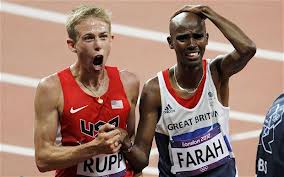
Coming into London, the US men's 5000m team looked to be the strongest chance for a distance medal of all the races on the Olymic slate. The team included multiple-world champion and American record holder Bernard Lagat, American record holder Galen Rupp, and former 1500m specialist Lopez Lomong. All three men made it through the heats to the Olympic Final including Rupp, newly minted in silver from his brilliant triumph in the 10000m.

 The looming question was whether Britain's Mo Farah could double up on his gold medal win from the 10000m. The best take on how the race unfolded, a very slow tactical affair with a bunched field until the bell lap, was this note from the Atlantic Wire:
Mo Farah is emerging from these Olympics as Briton's breakout hometown hero. After winning gold in the 10,000 meters last week he said he was tired. He wasn't sure he had enough in the tank to win the 5,000. But then someone reminded him that 5,000 meters is, like, half of 10,000. And he's so good at the 10,000! Gold medal good, even. So Farah was all like, "I got this," and he totally dominated Saturday's race on the way to his second gold of this Olympics.
Lagat congratulating the champion
Hahaha - that just cracked me up because that's a pretty good read of how the race went down. Rupp looked tired too, and although he moved up into a strong position with two laps remaining he almost immediately faded from the front and ended in seventh. Respectable, but out of the medals. Lagat hung tough and may have moved into bronze on the finishing sprint if not for a small stutter and near-trip. He finished fourth. Farah's gold was Britain's first Olympic win in the event. Full results here (Race video here - beginning at 0:55:40)

The reason why most championship races tend to unfold so slowly is because front-running in an elite caliber field is an almost certain way to lose the race (this is the reason rabbits are used in non-championship races - to keep the pace honest). Allowing a slow pace might seem counter-intuitive for runners that lack a kick because such a tactic all but assures that the best kickers will win anyway. But a runner that chooses to push the pace from the front simply allows the rest of the field to easily tuck and draft, then attack with fresher legs at the finish. Often times national teams will employ team-tactics by swapping leads to push the pace, then sacrificing their least talented athlete as the pacesetter toward the crucial point in the race.

In a rare example of what it takes to front-run and win, Kenyan great John Ngugi (below) jumps the field in the 1988 5000m Olympic Final. Ngugi had the skill and credentials to pull this off but to do it successfully he had to surprise the field with sub-4min mile pace for two laps early in the race. A phenomenally bold move to throw down in an Olympic Final. Note the Portuguese who gambles his own race for gold to see just how difficult such a move can be. 

1988 5000m Olympic Final - Seoul, Korea

2012 London Olympics
 - Olympic 800m Recap
 - Olympic 1500m Recap
 - Olympic 3000m Steeplechase Recap
 - Olympic 5000m Recap
 - Olympic 10,000m Recap
 - Olympic Marathon Recap
 - Week One: The Olympic Vortex

Tuesday, August 21, 2012

Olympic 10,000m Recap

Rupp and Farah leading everyone on the planet
Continuing a short series of posts - A quick look back at the 10,000m Olympic Finals:

This was the big race that runners across the country had circled on their calendar. For the first time in a couple of generations, the US team had a runner in the field - Galen Rupp, formerly of the Univ. of Oregon - that had a legitimate shot of cracking the formidable talent of the East Africans and finding his way to the podium. Rupp's primary weapons are that he trains with the current World Champion and world no.1, Mo Farah of Great Britain, and that he has the finishing speed to close the race with a 53sec final lap. Only a half dozen of the world's elite distance runners have that kind of closing speed, Farah is one of them. With that said, the drama surrounding the race became a question of whether Rupp could step-up and resist cracking under the pressure of an Olympic Final, and whether the rest of the world's top distance runners would pursue a strategy to press a fast enough pace throughout the race to negate the kick of the favorites.

My man Dathan representing Boulder in the early going
The race began slowly as the runners found their legs, then Team Eritrea went hard to the front after the first mile and began alternating leads and pressing a strong pace (27min pace). Long time fixtures of the American distance scene Dathan Ritzenhein formerly of the Univ. of Colorado (Go Buffs!) and Matt Tegenkamp formerly of the Univ. of Wisconsin, were mixing it up in the lead pack through the first 6000m. As the race drama peaked over the last few thousand meters the Eritreans fell back to recover as both the Ethiopian and Kenyan contingents were chattering with one another at the front, debating their next move. They chose to sit and kick. Rupp held onto fourth position on the rail and all the front runners held tight until the bell.

Farah bossin' it in front of the adoring British crowd
Farah set off the bedlam by surging into the final lap. The London crowd roared their approval and the chase was on. The surge created space for Rupp to come off the rail and he was one of five that were away and chasing medals; Farah, one Kenyan, Kenenisa Bekele of Ethiopia (the world record holder and two-time Olympic champion), Bekele's brother Tariku, and Rupp. I stared at the television and thought to myself - an American is in position to conceivably win this race!? Oh shit, this was seriously going to happen. Rupp showed steely patience in lane two with the frightening shadow of Bekele on his heels, and then went all-in on the top of the bend, pushing past the fading Kenyan (bronze!), then on the homestretch the Ethiopian began to falter and Rupp overtook him 40 meters to the line (silver!), and then it was over!

Disbelief at the finish
I was in the pediatric ward of the hospital as this was happening. My brother and I, eyes glued to the set were whispering to each other this whole time, miming the tension and disbelief of those last four laps, and with great discipline and restraint, not yelling. Just then I hear my wife - who dislikes talk of running and related nonsense - calmly ask from behind us, 'wait, did Rupp just win a medal?'. Yes, he most certainly did. What a magnificent race.  Results here  (Race video here - beginning at 2:29:30)

Whew, well I'll follow that with a quick clip of another of the finest Olympic 10000m finishes of all-time. Greats Paul Tergat and Haile Gebrselassie battle for gold at the Sydney Games - in slow motion backed with opera music. A bit of a do-it-yourself job, but quite marvelous just the same.

Tergat and Gebrselassie - Sydney 2000

2012 London Olympics 
 - Olympic 800m Recap
 - Olympic 1500m Recap
 - Olympic 3000m Steeplechase Recap
 - Olympic 5000m Recap
 - Olympic 10,000m Recap
 - Olympic Marathon Recap
 - Week One: The Olympic Vortex

Sunday, August 19, 2012

Olympic 800m Recap

Rudisha at the finish. Symmonds (far left), Solomon (center-left)
Continuing a short series of posts - A quick look back at the 800m Olympic Finals:

The US men have been exceptionally deep in the middle distances this year, and in the 800m the rare opportunity to place a man on the Olympic podium seemed more likely than not. The problem: Kenya's David Rudisha is the most dominant athlete in track and field not named Bolt, meaning that the available podium spots for the remainder of the field were just two.

Two men from the US contingent of three navigated their heats into the final, Duane Solomon , formerly of USC, and five-time US National Champion Nick Symmonds of Oregon. Unlike most championship races that play out tactically (read: slowly - see all other recapped races), this one was the race that David Rudisha had likely been waiting his entire life for. An historically deep field, roaring crowds, massively high-stakes and soaring adrenaline. At the gun he blasted straight to the front, mashed the pedal down in the first half of the second lap when runners generally relax and gather themselves for the sprint home, then sent that last 200m for a new world record (1:40:91) and Olympic gold. As masterful and bold a performance as any in the London Games. In his wake, he dragged every other runner but one to a personal best time. Three of the eight runners, including himself, ran to a new national record. The finishing time for each place in the race, one through eight, were all-time bests for that place. It was the greatest 800m race ever run. Amid all of this, the Americans honorably held it together for 4th and 5th place finishes. Out of the medals yes, but with the second and third fastest finishes in US history - D. Solomon (1:42:82), N. Symmonds (1:42:95). One really couldn't ask for better performances in an Olympic Final. Results here  (Race video here - beginning at 1:44:00)

This was Kenya's fourth gold medal in the event over the last seven Games, going back to Seoul in 1988. The US last stood on the podium in 1992 when Johnny Gray (still the US record holder and coach to D. Solomon), won bronze.


Rudisha - Fortune favors the bold

An interesting stadium-seat view of the race as it unfolds. The Americans run near the back of the field until closing hard at the finish. 

2012 London Olympics 
 - Olympic 800m Recap
 - Olympic 1500m Recap
 - Olympic 3000m Steeplechase Recap
 - Olympic 5000m Recap
 - Olympic 10,000m Recap
 - Olympic Marathon Recap
 - Week One: The Olympic Vortex

Saturday, August 18, 2012

Olympic 1500m Recap

Leo Manzano - Olympic silver medalist
Continuing a short series of posts - A quick look back at the 1500m Olympic Finals:

Following an uncharacteristically good showing at Worlds last year (Simpson winning the womens title - go Buffs!, Centrowitz taking mens bronze) there was some question as to whether the Olympic contingent could continue to punch above their weight. What our milers lack in raw speed seems to be balanced by their collective savvy as racers. The men did not disappoint.

Manzano (triumphant) and Centrowitz at the line
Leo Manzano and Matt Centrowitz both made it through heats to the finals and followed a slow pace to the bell along with most of the field. The eventual champion from Algeria broke the race open on the backstretch with an improbable surge covered by the race favorites from Kenya and Ethiopia. All of these men but the Algerian faded badly on the homestretch where Manzano reeled them in with the closing acceleration he's known for, climbing the ladder to a silver medal (3:34:79). Centrowitz followed closely, barely losing out on bronze (3:35:17). Manzano's kick to glory was reminiscent of his win at the Trials and at Indoor Nats in Albquerque this February (where he incidentally kicked down Rupp and Centrowitz). A marvelous run for the Americans and a vindication that US runners are once again a threat on the elite level. Manzano in silver claimed the first American Olympic 1500m medal since Jim Ryun in 1968 (yes, Jim Ryun). Results here (Race video here - beginning at 2:28:00)

Uceny - an Olympic final (and years of work) abruptly fade
While the US men performed way above expectation, the women ran nearly the opposite. All of the Americans were possible medal threats with current world number one Morgen Uceny, defending world champ Jenny Simpson (go Buffs!), and Shannon Rowbury a former worlds bronze medalist. Simpson inexplicably washed out in the heats, and Uceny - repeating the disaster of last year's World Championships - tripped up in traffic and crashed to the track at the bell, failing to finish. Absolutely crushing to see that happen to her in two straight championships. Rowbury hung on for a solid 6th place finish (4:11:26). Results here (Race video here - beginning at 2:04:27)

A bit of video of Ryun at the Mexico City Games. The Kenyans intentionally drive the pace to use the 7000ft altitude to their advantage. Ryun leaves it way too late to respond. Kip Keino's winning time - at altitude, in 1968 - was less than a second shy of the winning time in London (3:34:86).

Keino vs. Ryun in Mexico City - 1968


2012 London Olympics
 - Olympic 800m Recap
 - Olympic 1500m Recap
 - Olympic 3000m Steeplechase Recap
 - Olympic 5000m Recap
 - Olympic 10,000m Recap
 - Olympic Marathon Recap
 - Week One: The Olympic Vortex


Olympic Steeplechase Recap

Coburn running in CU kit at the Trials
This year's Olympics were sweeeeet, and the US distance contingent was the strongest to suit up since at least the '84 Games in Los Angeles. With this in mind I wanted to look back at a few of the races and draw some context over previous Olympic years - beginning with the Steeplechase.

Fronting the women's team was Emma Coburn (two time National Champion) and Shalaya Kipp, both collegiates from the University of Colorado (Waddup!). Coburn made the finals - along with the third member of team USA, Bridget Franek - and ran to a 9th place finish in a personal best time of 9min 23s. Results here. (Race video here - beginning at 2:26:30).Coburn redshirted her senior year of eligibility at CU to train exclusively for London. It's the second straight Olympics that the top American Steeplechaser hails from CU (U.S. record holder Jenny Simpson in '08).

Jager and Cabral drive the early pace
In the men's race, the top American was U.S. record holder Evan Jager running in just the seventh steeple race of his career. He knocked out a very respectable 6th place finish (8:23.87, best US finish since 1996), followed closely by recent Princeton graduate Dan Cabral in 8th (8:25.91). Both Americans were in the lead group at the bell but fell well off pace in a blistering final lap. Results here. The race was dominated by the '04 Gold Medalist and double world champ Ezekiel Kemboi of Kenya who toyed with the field in the heats, then celebrated this win with his usual lane-7 finish followed with some memorable dancing on the track (Race video here - beginning at 2:48:40).

An incredible observation: Kenya has won steeplechase gold in every Olympic year they've sent a team going back to 1968 (African boycott in '76; Soviet boycott in 1980). That's 44 years. Below is some video of the finish in '68. The leader on the final turn  is none other than Silver City's George Young, who finished in bronze.

1968 Olympic Steeplechase Final - Mexico City

2012 London Olympics 
 - Olympic 800m Recap
 - Olympic 1500m Recap
 - Olympic 3000m Steeplechase Recap
 - Olympic 5000m Recap
 - Olympic 10,000m Recap
 - Olympic Marathon Recap
 - Week One: The Olympic Vortex


Sunday, July 29, 2012

The Olympic Vortex

I thought I'd have time to write more about cycling with the recent end to the Tour and Olympic track and field still one week away. But good Lord, the Olympics just overwhelm don't they? I neither have the time right now to write or follow the Games but the discipline of my attention span is notoriously poor, so a few notes on the first week in London:

  • This year's Tour de France champion was British rider Bradley Wiggins. He was the first Brit in the Tour's long history to finish in yellow, but also the first former track cyclist to win in Paris. Wiggins has multiple medals, including several gold, from the velodromes in Sydney, Athens, and Beijing. This year's champion in the Giro was Canadian rider Ryder Hesjedal, the first Canadian to claim the pink jersey. He also came to the cycling via early successes in mountain biking, including an Olympic appearance in Athens in which a flat tire spoiled a probable ride to the podium. With all this in mind who would win the Olympic Road Race on the first day in London? Savy veteran Alexandre Vinokourov of Kazakhstan stole the race from upfront as the favored Brits tried to control the race from the peloton and set up their best sprinter Mark Cavendish.

  • A vivid illustration of the difference between being an Olympic champion and becoming the stuff of Olympic legend. Human laser-beam and fastest-man-on-the-planet Usain Bolt joined his Jamaican teammates for a trip to the dining hall in the Athlete’s Village. The place quickly erupted into a prolonged standing ovation of fellow Olympians. The throwers in his entourage quite literally found themselves in the role of bouncers and personal security detail for the guy.

  • I was secretly hoping to see one of the legends of sport - Roger Bannister - light the Olympic torch in London. His fame isn’t tied to the Games as much as to his challenges with a stopwatch on the Iffley oval in Cambridge. Bannister’s shot at Olympic glory fell to pieces in 1952 as he faded late in the race to fourth. It was this failure ironically that motivated his efforts in training that produced the world’s first fourminute mile two years later, after which, he retired to a career in medicine. I was hoping the Games organizers would look past this technicality, but they chose not to.

  • There are reports that marathon world-record holder and part-time Albuquerque resident Paula Radcliffe will be a scratch for next Sunday’s womens marathon. Old foot injuries continue to bother her. Radcliffe hasn’t raced much over the last few years and one has to imagine she may have hung up the flats before now had London not been the host of this year’s games. American marathoner Desi Davila is also a likely scratch. Alternates from the Trials would be Amy Hastings or Janet Bawcom, both already qualified and set to compete in the 10000m. The next alternate would be none other than Deena Kastor. It remains to be seen if any of the alternates are prepared to run.
2012 London Olympics
 - Olympic 800m Recap
 - Olympic 1500m Recap
 - Olympic 3000m Steeplechase Recap
 - Olympic 5000m Recap
 - Olympic 10,000m Recap
 - Olympic Marathon Recap
 - Week One: The Olympic Vortex


Friday, December 16, 2011

Armijo Runs to an Olympic Trials Qualifier

Kandie and Armijo, side-by-side at CIM
After several previous attempts at a trials marathon qualifier, Albuquerque's Jesse Armijo put together a beaut of a race in Sacramento a couple weeks back, running to a sixth place 2hr 17:19 finish. That's a helluva run, especially considering it was a back-against-the-wall type situation. The qualifying standard for January's Olympic Trials race is a stiff 2hr 19min, and Sacramento's California International Marathon was likely the last fast race before the Houston Trials on January 14th. Armijo dipped under the standard considerably, running to a massive PR just ahead of fellow Albuquerque runner Solomon Kandie. Santa Fe's Joseph Mutinda converted his early morning rail-trail runs into a third place overall finish. Neither Joseph nor Solomon will be running in Houston.

Originally from California, Armijo has been studying and training in Albuquerque for several years with runners like Kris Houghton who had been targeting a qualifier himself. Jesse provides a pretty fascinating first-person account of his high-stakes marathon run in a great race report over at his blog. A clutch performance with a huge payoff after what I'd imagine was years of toil and effort. Way to go out and get it man! Along with Armijo, New Mexico will be represented at the Trials by Albuquerque's indomitable Mbarak Hussein, younger brother of former UNM All-American and multiple Boston Marathon champion Ibrahim Hussein. Mbarak ran a 2:16:57 qualifier to win the U.S. Masters Division title at the '10 Twin Cities Marathon. Dude's got wheels. 

Marathonguide.com has a listing of mens trials qualifiers and their seeded times here.

On the women's side, New Mexico will be represented in Houston by a couple of Los Alamos natives, All-American and former Adams State runner Heather McNiff (Wood) who qualified with a 2:43:53 run in June's Grandma's Marathon (MN), and former Oregon runner Magdalena Donahue (Sandoval) who qualified with a 2:44:41 run in May's Eugene Marathon. The women's Trials standard is 2hr 47min.

Marathonguide.com has a listing of women's trials qualifiers and their seeded times here.

Related Posts:
  - A Brief Meeting with Billy Mills
  - Olympic Marathon Trial Showdown
  - New Mexican Runners Chase the London Olympic Standards


LinkWithin

Related Posts Plugin for WordPress, Blogger...